
By Hassan Tadourdi, Mountain guide · Reviewed by Nizar Alami, Founder · Updated 2026-10-05
Climbing Mount Toubkal is one of North Africa’s great trekking challenges. This guide is part of our Atlas hiking guides and covers the 2-day vs 3-day decision, the best season, gear, costs, and logistics.
Quick answer: Quick answer Mount Toubkal (4,167 m) is North Africa’s highest peak and a non-technical but strenuous trek from Imlil. Most climbers choose a 2-day trek with an overnight at Toubkal Refuge, while a 3-day trek adds acclimatization and is better for beginners. The winter trekking season runs from the end of November to the end of April; outside that window conditions are generally easier. Guided tours start from around €120–€250 per person depending on group size and season, and you can rent crampons, ice axes, and sleeping bags in Imlil. The summit delivers a raw, rocky panorama across the Atlas spine and, on clear days, the Sahara horizon.
Why Mount Toubkal Deserves a Place on Your List
Mount Toubkal sits at 4,167 metres in the High Atlas range, roughly 60 kilometres south of Marrakech as the crow flies. It is not a technical peak — there is no glacier travel, no vertical ice, no fixed ropes — but it is a genuine high-altitude objective. The altitude, the relentless gradient above the refuge, and the winter snowpack make it a serious undertaking that demands respect.
The mountain lies inside Toubkal National Park, created in 1942 and now celebrating over 80 years of conservation. The park protects a landscape of jagged ridges, deep valleys, and Berber villages that have shaped the trekking culture of the region for centuries. When you climb Toubkal, you are walking through one of Morocco’s oldest protected areas, a place where geology and human history overlap in a way that few other summits can match.
For many trekkers, Toubkal is the first 4,000-metre peak they attempt. It is accessible — you can leave Marrakech after breakfast and be on the trail by midday — yet it delivers the full mountaineering experience: thin air, alpine starts, scree slopes, and the kind of summit euphoria that only comes after hours of sustained effort. That combination of accessibility and authenticity is what keeps the trail busy from spring through autumn and draws winter mountaineers when the snow transforms the route into a different challenge altogether.
2-Day vs 3-Day Trek: Which One Fits You?
Choosing between a 2-day and 3-day Toubkal trek largely depends on your fitness, hiking experience, and how you want to experience the mountain.
The 2-day trek is best suited to hikers who are short on time and comfortable with long, demanding days on the trail. You’ll cover more distance each day and have less time to acclimatize, making the summit push significantly more strenuous. It’s an efficient option, but you should be prepared for a tougher physical challenge.
The 3-day trek is the better choice if you prefer a more relaxed pace. The extra day allows you to break up the ascent, reduce daily mileage, and give your body more time to adjust to the altitude. For first-time Toubkal climbers, this can make the experience considerably more enjoyable—and give you a better chance of reaching the summit feeling strong.
In simple terms: choose 2 days for speed and challenge; choose 3 days for comfort, acclimatization, and a more enjoyable experience. If you’re unsure, the 3-day itinerary is generally the safer bet for first-time trekkers.
The most common question we hear from first-time climbers is whether to book a 2-day or 3-day Toubkal itinerary. Both options start and finish in Imlil (1,740 m), the traditional trailhead for the Toubkal massif. The real difference comes down to acclimatization, daily mileage, and how much suffering you’re willing to accept on summit day.
The 2-day itinerary is the faster, more demanding option. It packs the approach to Toubkal Refuge and the summit climb into a tight schedule, leaving little room for your body to adjust to the increasing altitude. For fit and experienced hikers, this can be a perfectly manageable challenge—but for first-time high-altitude trekkers, the short timeline can make summit day considerably harder.
The 3-day itinerary spreads the effort more evenly and gives you more time to acclimatize. You’ll spend less time rushing along the trail, allowing your body to adjust gradually as you gain elevation. That extra day can make a noticeable difference, particularly on the final ascent to Mount Toubkal’s 4,167 m summit.
So, which should you choose? If your priority is speed and efficiency, the 2-day itinerary may suit you. If you want a more comfortable pace, better acclimatization, and a more enjoyable overall experience, we generally recommend the 3-day option.
The Classic 2-Day Toubkal Trek
This is the itinerary that 80% of independent trekkers and guided groups follow. It is efficient, relatively affordable, and fits into a weekend if you are already in Marrakech.
Day 1: Imlil to Toubkal Refuge (Neltner Hut)
The trail leaves Imlil and climbs steadily through the Mizane Valley, passing the village of Aroumd and the Muslim shrine of Sidi Chamharouch. The walking is on a well-trodden mule path that gains roughly 1,400 metres of elevation over 10–12 kilometres. Most groups reach the refuge in 5–6 hours. At 3,207 metres, the Toubkal Refuge (often called the Neltner Hut) is a stone-built mountain hut operated by the French Alpine Club. It offers dormitory beds, basic meals, and a communal atmosphere that is half the experience.
Day 2: Refuge to Summit and Return to Imlil
Summit day starts early — typically between 4:00 and 5:00 a.m. — to reach the top before afternoon clouds or wind build up. From the refuge, the route climbs steeply up a scree-filled couloir, then traverses a ridge to the summit plateau. The final push gains about 960 metres of elevation and takes 3–4 hours. After a brief stay on the summit, you descend back to the refuge for lunch, then continue down to Imlil, arriving by late afternoon. Total walking time on day two is often 8–10 hours.
Pros of the 2-day trek:
- Lower cost (fewer guide days, one night of accommodation)
- Fits into a short travel window
- Feels like a fast, intense mountain mission
- Limited acclimatization: The rapid ascent gives your body less time to adjust to the altitude.
- Long, demanding days: Both days involve significant elevation gain and can be physically exhausting.
- Tough summit day: The summit push is followed by a long descent, making for a particularly strenuous day.
- Less time to enjoy the mountains: The fast pace leaves fewer opportunities to stop, explore, and take in the scenery.
- Higher risk of altitude-related symptoms: The quicker gain in elevation can make altitude sickness more likely, especially for those without previous high-altitude experience.
- Not ideal for everyone: First-time trekkers or hikers with limited mountain experience may find the 2-day schedule unnecessarily challenging.
- No acclimatization day; altitude sickness is more likely
- Summit day is very long (up to 10 hours of walking)
- If weather closes in on day two, you have no buffer
The 3-Day Toubkal Trek: A Smarter Acclimatization Schedule
Better acclimatization: The extra day gives your body more time to adjust to increasing altitude before summit day.
More manageable daily distances: Breaking the ascent into smaller stages makes each day less physically demanding.
A more comfortable summit day: Starting the final ascent better rested can make the biggest difference when the altitude and steep terrain start to bite.
Lower physical strain: The slower progression reduces the need to push through exhaustion, particularly on the approach to the refuge.
More time to enjoy the High Atlas: The relaxed pace gives you more opportunities to appreciate the mountain scenery, villages, and changing landscapes.
A better option for first-time climbers: If you’re new to high-altitude trekking, the 3-day itinerary offers a more forgiving introduction to Toubkal.
Greater chance of a successful summit: While no itinerary can guarantee reaching the top, better pacing and acclimatization can put you in a stronger position for summit day.
- Much better acclimatization; lower risk of AMS
- Summit day feels less punishing
- Extra time to enjoy the valley, villages, and scenery
- A buffer day if weather delays your summit attempt
- Less time to acclimatize to the altitude
- Longer and more physically demanding hiking days
- A particularly strenuous summit day
- Less time to enjoy the scenery and mountain villages
- Can be challenging for first-time high-altitude hikers
- Higher cost (extra guide day, extra accommodation)
- Requires three days away from Marrakech
Our recommendation: If you have never been above 3,000 metres, or if you are trekking with children or older family members, take the 3-day option. If you are fit, have recent altitude experience, and are on a tight schedule, the 2-day trek works — but be prepared for a very long second day.
Best Season to Climb Mount Toubkal
or most trekkers, late spring through early autumn—roughly May to October—is the best time to climb Mount Toubkal. During these months, the trails are generally more accessible, snow is limited at higher elevations, and conditions are better suited to trekking without technical winter equipment.
June to September offers the most straightforward trekking conditions, with longer daylight hours and relatively warm weather. However, summer can also bring hot temperatures at lower elevations and more visitors on the most popular routes.
May and October can be excellent choices for hikers looking for cooler temperatures and a quieter experience. Conditions can be more variable, though, particularly at higher elevations, where snow and cold weather can still occur.
Winter ascents from roughly November to April are a very different proposition. Snow and ice can cover the upper mountain, and crampons, an ice axe, and appropriate winter mountaineering skills may be required depending on conditions.
If this is your first Toubkal trek, the summer season or the shoulder months of May and October generally offer the best balance of accessibility, weather, and overall trekking conditions.
Spring (April to May)
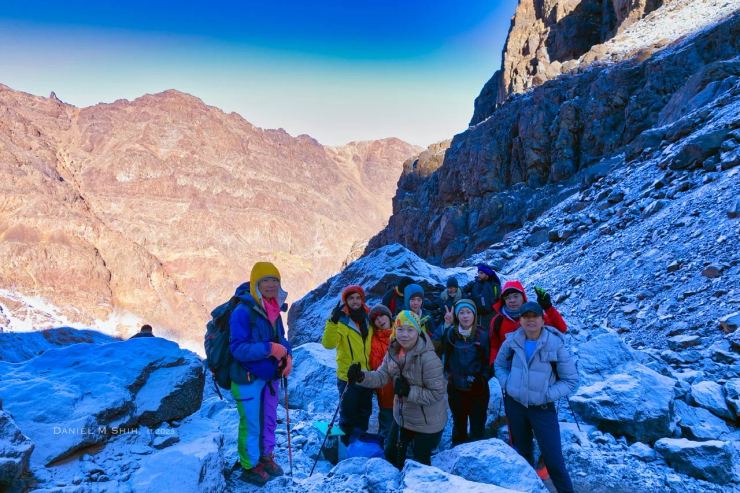
Spring brings a mix of winter and summer conditions to Mount Toubkal. Lower sections of the trail begin to thaw, temperatures become more comfortable, and the High Atlas starts to come alive after winter. However, snow can still cover the upper slopes and summit route, particularly in April.
For experienced hikers, spring can be an excellent time to climb, offering cooler temperatures and fewer trekkers than the peak summer months. May generally provides more favorable trekking conditions than April, although snow and rapidly changing weather can still be encountered at higher elevations.
If you're planning a spring ascent, be prepared for variable conditions and check current trail and weather conditions before setting out. Depending on the amount of snow, crampons and an ice axe may still be necessary for the higher sections.
Summer (June to September)
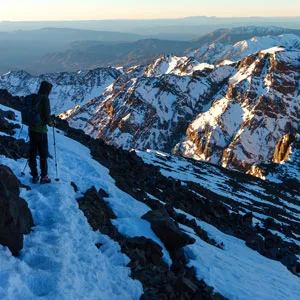
Summer is the classic trekking window. The snow is gone, the route is entirely on rock and scree, and temperatures at the refuge can be warm even at night. The main challenge in summer is heat on the lower sections of the trail — start early to avoid the midday sun. Afternoon thunderstorms are possible in July and August, which is why summit-day starts remain early even in summer. This is the easiest season logistically: no crampons, no ice axes, just sturdy boots and trekking poles.
Autumn (October to early November)
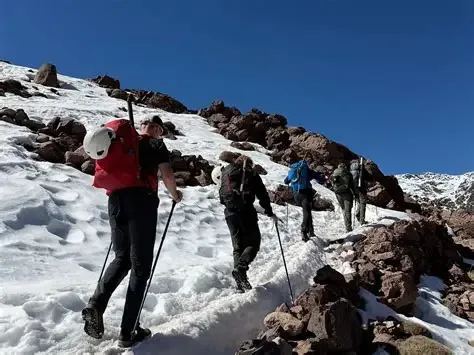
Autumn rivals spring for the best overall conditions. The summer heat has faded, the air is crisp, and the days are still long enough for comfortable trekking. The first snow usually arrives in late November, so October is reliably snow-free. The refuge is quieter than in spring, and the low-angle light makes the High Atlas look spectacular.
Winter (late November to end of April)
Winter transforms Toubkal into a proper mountaineering objective. Snow covers the route from Aroumd upwards, and above the refuge you will be travelling on consolidated snow and ice. Crampons and an ice axe are mandatory; many guided groups also use ropes on the steeper sections. The winter season officially runs from the end of November to the end of April, though conditions vary — December and January are the coldest months, with nighttime temperatures at the refuge dropping well below -10°C. Winter ascents require more gear, more experience, and a higher level of fitness, but they reward you with a quiet mountain and a true alpine atmosphere.
Key seasonal note: The Toubkal Refuge remains open year-round, but in heavy snow periods access can be slow. Always check conditions with your guide or the refuge before departing.
Gear: What You Need and What You Can Rent in Imlil
One of the best things about climbing Toubkal is that you do not need to bring a full mountaineering kit from home. Imlil has several gear shops that rent everything from crampons to sleeping bags. This makes the trek accessible to travellers who are visiting Morocco for a broader trip and do not want to carry bulky equipment.
Essential Gear for a Summer/Autumn Ascent (Snow-Free)
- Boots: Sturdy hiking boots with good ankle support. Trail runners are not recommended — the scree is sharp and the descent is hard on feet.
- Daypack: 25–35 litres, enough for water, layers, snacks, and a camera.
- Clothing: Lightweight trekking trousers, a base layer, a fleece or insulated mid-layer, and a waterproof/windproof jacket. Even in summer, the summit can be cold and windy.
- Trekking poles: Highly recommended. They save your knees on the long descent and help with balance on loose scree.
- Sleeping bag liner or light sleeping bag: The refuge provides blankets, but a liner adds hygiene and warmth.
- Headlamp: Essential for the pre-dawn summit start.
- Water bottles or bladder: 2–3 litres capacity. There is water at the refuge, but you need to carry enough for each day’s walking.
- Sun protection: Hat, sunglasses, and high-SPF sunscreen. The UV at 4,000 metres is brutal.
Additional Gear for a Winter Ascent (Snow and Ice)
- Crampons: Must fit your boots. Available for rent in Imlil (around 30–50 MAD per day).
- Ice axe: A general mountaineering axe. Also rentable in Imlil (similar pricing).
- Mountaineering boots: Stiffer than summer boots, compatible with crampons. Some shops in Imlil rent these, but sizing can be limited — if you have large or small feet, consider bringing your own.
- Gaiters: To keep snow out of your boots.
- Warmer clothing: A down or synthetic insulated jacket, thermal base layers, and insulated gloves. Winter nights at the refuge are very cold.
- Four-season sleeping bag: The refuge blankets are not enough in winter. You can rent sleeping bags in Imlil, but quality varies — check the condition before you commit.
What You Can Rent in Imlil
Imlil’s rental shops are clustered near the main square and along the road to Aroumd. Typical rental prices (2026) are:
| Item | Approximate Daily Rental (MAD) |
|---|---|
| Crampons | 30–50 |
| Ice axe | 30–50 |
| Trekking poles | 20–30 |
| Sleeping bag | 40–60 |
| Mountaineering boots | 50–80 |
| Gaiters | 20–30 |
| Headlamp | 15–25 |
Most shops ask for a deposit (cash or passport) and inspect gear upon return. Availability is generally good, but in peak spring weeks the best gear goes fast — arrive early or have your guide reserve items in advance.
Costs: Guided Tours, Refuge Stays, and Budget Breakdown
Climbing Toubkal is one of the most affordable 4,000-metre peaks in the world, but costs vary depending on whether you join a group, hire a private guide, or attempt the trek independently.
Guided Tour Prices (2026)
The majority of climbers use a guide. This is not strictly mandatory — Toubkal is on public land — but a guide adds safety, local knowledge, and logistical ease. Most tours include transport from Marrakech, guide fees, refuge accommodation, and meals.
Typical price ranges per person:
2-day group trek: €120–€180. Larger groups (8–12 people) bring the per-person cost down.
2-day private trek: €200–€300 for a solo trekker; €150–€250 per person for couples or small groups.
3-day group trek: €180–€250.
3-day private trek: €280–€400 for a solo trekker; €200–€300 per person for small groups.
Winter ascents: Add 20–40% to the above prices. Winter requires a guide with mountaineering qualifications, and the guide-to-client ratio is smaller (often 1:3 or 1:4).
Round-trip transport from Marrakech to Imlil
Guide fees for all days
Accommodation (refuge dormitory or guesthouse)
Meals during the trek (breakfast, packed lunch, dinner)
Cooking equipment and mule support for larger groups
Gear rental (crampons, ice axe, sleeping bag, etc.)
Tips for the guide and muleteer (budget 10–15% of the tour cost)
Personal snacks and drinks
Travel insurance
Independent Trek Costs
If you trek without a guide, your costs can drop significantly, but you’ll take responsibility for all the logistics yourself. That means planning your route, arranging accommodation, navigating the trail, organizing meals, and preparing for changing mountain conditions.
For experienced hikers, this can be a rewarding and budget-friendly option. However, first-time visitors may find the added planning and responsibility outweigh the savings, particularly when tackling a high-altitude summit like Toubkal.
- Transport: Grand taxi from Marrakech to Imlil: 200–300 MAD per taxi (shared by up to 6 passengers). Public bus: around 30 MAD but slower and less frequent.
- Refuge accommodation: 150–200 MAD per night for a dormitory bed. Blankets included; meals extra.
- Refuge meals: Breakfast ~40 MAD, dinner ~80 MAD, packed lunch ~50 MAD.
- Gear rental: As listed above.
- Total independent 2-day cost: Roughly 500–800 MAD (€50–€80) excluding gear rental, assuming shared transport and refuge meals.
** Important note on independent trekking:** The route is well-marked in summer, but in winter navigation is challenging and avalanche risk exists in certain conditions. If you are not experienced in winter mountaineering, hire a guide.
Tipping Etiquette
Tipping is customary in Moroccan trekking culture. For a 2-day guided trek, a typical tip is 200–300 MAD for the guide and 100–200 MAD for the muleteer. For a 3-day trek, increase proportionally. Tips are shared directly with the team at the end of the trek.
The Route in Detail: What to Expect Step by Step
Understanding the terrain helps you prepare mentally and physically. Here is a section-by-section breakdown of the standard Toubkal route from Imlil.
Imlil to Aroumd (1,740 m to 1,960 m)
The trek starts in Imlil, a bustling mountain town that serves as the gateway to the High Atlas. The first section is a gentle warm-up: a wide dirt track that contours above the Mizane River, passing apple orchards and walnut groves. After 30–40 minutes you reach Aroumd, a traditional Berber village of stone houses built into the hillside. Many 3-day itineraries overnight here. If you are on a 2-day trek, you pass through without stopping.
Aroumd to Sidi Chamharouch (1,960 m to 2,310 m)
Beyond Aroumd, the trail narrows and begins to climb more steeply. The valley walls close in, and the sound of the river accompanies you. After about an hour you reach Sidi Chamharouch, a whitewashed shrine built around a large boulder. This is a pilgrimage site and a popular rest stop. There is a basic café and a few shelters. The altitude is now above 2,300 metres, and you may start to feel the thinner air.
Sidi Chamharouch to Toubkal Refuge (2,310 m to 3,207 m)
This is the hardest section of day one. The trail leaves the shrine and climbs in earnest, switchbacking up the valley headwall. The terrain becomes rockier, the vegetation thins, and the views open up to reveal the peaks of the Toubkal massif. The final 45 minutes are a steady plod up a scree slope to the refuge, which sits on a shoulder above two valleys. At 3,207 metres, the Toubkal Refuge (Neltner Hut) is a solid stone building with dormitories, a dining room, and a terrace with a view of the summit. It is basic but welcoming — hot tea, hot food, and the company of other trekkers from around the world.
Refuge to Summit (3,207 m to 4,167 m)
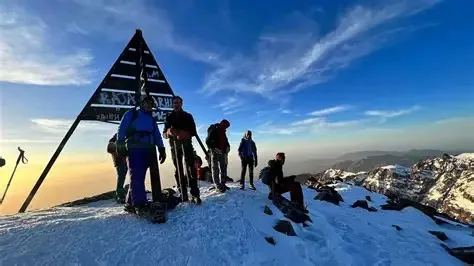
Summit day begins in the dark. From the refuge, the route climbs south-east up a steep scree couloir. In summer this is loose and tedious — two steps up, one step back. In winter it is snow-covered and crampons make the ascent faster and more secure. After the couloir, the angle eases as you reach a broad ridge. The summit plateau is marked by a metal tripod and offers a 360-degree panorama: the High Atlas stretching north and east, the Anti-Atlas and, on very clear days, the Sahara to the south.
The descent follows the same route. Take your time — most injuries happen on the way down, when legs are tired and concentration slips.
Refuge to Imlil
After summiting and returning to the refuge, you pack your gear, eat lunch, and begin the descent to Imlil. The downhill is faster than the ascent — 3–4 hours from refuge to trailhead — but it is hard on knees and toes. Trekking poles are invaluable here. You will arrive in Imlil by late afternoon, tired but elated.
Physical Preparation: How Fit Do You Need to Be?
Toubkal is non-technical, but it is physically demanding. The 2-day itinerary involves roughly 2,400 metres of ascent and 2,400 metres of descent over two days, with a summit day that can last 10 hours. That is a serious workload at altitude.
Recommended baseline fitness:
- You should be comfortable hiking 15–20 kilometres with 1,000+ metres of elevation gain in a day.
- Recent experience at altitude (above 3,000 metres) is helpful but not essential if you choose the 3-day itinerary.
- Cardiovascular fitness matters more than strength — long, steady climbs favour endurance over power.
Build your endurance: Include regular hiking, brisk walking, running, cycling, or stair climbing to improve cardiovascular fitness.
Train on hills: Practice sustained uphill and downhill walking whenever possible. If you live somewhere flat, use stairs or a treadmill with an incline.
Strengthen your legs: Focus on squats, lunges, step-ups, calf raises, and other exercises that prepare your legs for long climbs and descents.
Carry a backpack: Gradually train with the pack you’ll use on Toubkal, increasing the weight as your fitness improves.
Practice long hikes: Include regular longer walks or hikes to get comfortable spending several hours on your feet.
Train consistently: Aim for several weeks of progressive training rather than trying to build fitness in the final days before your trek.
Don't neglect recovery: Rest days, sleep, hydration, and gradual increases in training volume are just as important as the workouts themselves.
- In the 6–8 weeks before your trek, do at least one long hike per week with significant elevation gain.
- Stair climbing with a loaded pack is excellent preparation.
- If you live in a flat area, use a treadmill at maximum incline or a step machine.
- Do not neglect the descent — eccentric leg strength (quads, calves) reduces knee pain on the long downhill. Lunges and step-downs help.
Altitude sickness (AMS): Symptoms include headache, nausea, fatigue, and shortness of breath. The risk is real on a 2-day trek because you sleep at 3,207 metres on the first night. The 3-day itinerary reduces the risk significantly. If symptoms become severe (confusion, loss of coordination), descend immediately.
How to Book a Mount Toubkal Trek
There are several ways to arrange your Toubkal climb, each with different trade-offs in cost, flexibility, and support.
Book Online Before You Travel
Booking in advance gives you certainty and allows you to research guides and operators. Many Marrakech-based tour companies offer Toubkal treks as standalone packages or as add-ons to longer Morocco itineraries. If you are already planning a broader trip, consider combining Toubkal with one of our multi-day tours:
- Morocco Photography Tour — 8 Days — From €1190/person. A visual journey through Morocco’s most photogenic landscapes, from the Atlas to the desert.
- 14-Day Morocco Classic Tour — From €1890/person. The complete Moroccan experience, including imperial cities, the Sahara, and the High Atlas.
- 10-Day Atlantic to Sahara Tour — From €1390/person. Coast, mountains, and desert in a single itinerary.
- Marrakech, Sahara & Fes — 6 Days — From €840/person. A compact route hitting Morocco’s highlights.
These tours do not include a Toubkal ascent by default, but we can often add a 2- or 3-day Toubkal extension at the start or end of the itinerary. Contact us to discuss custom options.
Book Through a Local Agency in Marrakech
If you prefer to book in person, Marrakech has dozens of trekking agencies, many clustered around the Jemaa el-Fna area and in the Guéliz district. Booking locally can be cheaper, but quality varies. Ask to see the guide’s credentials — a certified mountain guide will have a card from the Moroccan Ministry of Tourism or the Fédération Royale Marocaine de Ski et Montagne. Read recent reviews, and be wary of prices that seem too low.
Book Through an Online Platform
Platforms like GetYourGuide and Viator list Toubkal treks from multiple operators. These platforms offer customer reviews, secure payment, and cancellation policies, which adds a layer of protection. Prices are often competitive, though the platform takes a commission so the guide receives less than the listed price.
Hire a Guide Directly in Imlil
It is possible to arrive in Imlil and hire a guide on the spot. The Bureau des Guides in Imlil can connect you with a certified guide. This is the most flexible approach and can be the cheapest, but it carries risk: in busy periods, good guides may already be booked, and you have no recourse if the guide does not meet expectations. If you go this route, agree on the full itinerary, price, and what is included before you set foot on the trail.
Combining Toubkal with a Longer Morocco Trip
For many travellers, Toubkal is the active centrepiece of a broader Moroccan journey. Marrakech is the natural base — it is the closest major city to the trailhead and the place where most Toubkal treks begin and end. A common itinerary looks like this:
- Days 1–3: Explore Marrakech (medina, souks, gardens, food).
- Days 4–5: 2-day Toubkal trek.
- Days 6–9: Desert tour to the Sahara (Erg Chebbi or Erg Chigaga), returning via the Dades Valley and Aït Benhaddou.
- Days 10–12: Fes and the Middle Atlas, or the Atlantic coast (Essaouira).
This rhythm — city, mountains, desert, coast — gives you a complete Moroccan experience without feeling rushed. Our multi-day tours are designed to fit this pattern, and we can help you slot a Toubkal ascent into the schedule.
Environmental Responsibility on Toubkal
Toubkal National Park faces pressure from the thousands of trekkers who visit each year. A few simple practices help protect the mountain:
- Carry out all waste. There are no bins above Imlil. Pack out wrappers, bottles, and tissues.
- Use the refuge toilets. The refuge has basic toilet facilities. On the trail, if you must go, bury waste away from water sources and carry out toilet paper.
- Stay on the trail. Cutting switchbacks accelerates erosion. The path is there for a reason.
- Respect the shrine. Sidi Chamharouch is an active pilgrimage site. Dress modestly, speak quietly, and do not photograph people without permission.
- Support the local economy. Hire local guides, eat at local guesthouses, and buy supplies in Imlil rather than bringing everything from Marrakech.
Frequently Asked Questions
Do I need a guide to climb Mount Toubkal?
No, a guide is not legally required. Toubkal is on public land and the summer route is well-marked. However, a guide adds safety, local knowledge, and logistical support. In winter, a guide is strongly recommended due to navigation challenges and avalanche risk.
How difficult is Mount Toubkal compared to other 4,000-metre peaks?
Toubkal is considered one of the easier 4,000-metre peaks in the world. It requires no technical climbing skills in summer. The main challenges are altitude, the long summit day, and the loose scree. In winter, it becomes a moderate snow climb requiring crampons and ice axe skills.
Can beginners climb Mount Toubkal?
Yes, with the right preparation and itinerary. A 3-day trek with an acclimatization day makes Toubkal achievable for fit beginners who have done some hillwalking. If you have never hiked before, Toubkal is not the place to start — build experience on lower-elevation trails first.
What is the success rate for summiting Toubkal?
For guided groups on a 2-day itinerary, the success rate is roughly 70–80%. The main reasons for turning back are altitude sickness, weather, and insufficient fitness. On a 3-day itinerary, the success rate is higher — closer to 85–90% — because of better acclimatization.
Is there phone signal on Mount Toubkal?
Mobile signal is patchy. You may get a weak signal at the refuge and on parts of the summit ridge, but do not rely on it. Download offline maps before you go, and consider a satellite communicator if you are trekking independently in winter.
What is the Toubkal Refuge like?
The Toubkal Refuge (Neltner Hut) is a stone mountain hut at 3,207 metres. It has dormitory rooms with bunk beds and blankets, a dining room serving hot meals, and basic toilet facilities. There is no heating in the dormitories, so nights are cold even in summer. It is operated by the French Alpine Club and is the only accommodation above Sidi Chamharouch.
Can I climb Toubkal in one day?
A single-day ascent from Imlil is possible but extremely demanding — roughly 2,400 metres of ascent and the same descent, totalling 25–30 kilometres and 12–16 hours of walking. Only very fit and altitude-acclimatized trekkers should attempt this. Most people should stick to the 2- or 3-day options.
What wildlife might I see on the trek?
The Toubkal massif is home to Barbary sheep (aoudad), which are sometimes spotted on the higher slopes, and a variety of birds including raptors like the bearded vulture. In the valleys, you may see lizards, butterflies, and flowering plants in spring. Large mammals are shy and sightings are not guaranteed.
How do I get from Marrakech to Imlil?
Most guided tours include transport. Independently, you can take a grand taxi from Marrakech (around 200–300 MAD per taxi, shared by up to 6 people) or a public bus (cheaper but slower). The drive takes about 1.5–2 hours. There is no train service to Imlil.
What happens if the weather is bad on summit day?
Your guide will assess conditions. If weather is unsafe (high winds, heavy snow, zero visibility), the summit attempt will be postponed or cancelled. On a 2-day trek, there is no buffer day, so a weather cancellation means you descend without summiting. A 3-day trek offers more flexibility to wait a day.
Do I need travel insurance for a Toubkal trek?
Yes. Standard travel insurance may not cover trekking above 3,000 metres. Check your policy and ensure it covers high-altitude trekking, emergency evacuation, and medical expenses. Helicopter evacuation from the High Atlas is possible but expensive — insurance is essential.
Are there age limits for climbing Toubkal?
There are no formal age limits. We have seen fit children as young as 10 summit on a 3-day itinerary, and trekkers in their 70s reach the top with good preparation. The key factors are fitness, altitude tolerance, and choosing an appropriate itinerary. Consult a doctor if you have any health concerns.
Final Thoughts: Is Mount Toubkal Right for You?
Mount Toubkal is a mountain that meets you where you are. If you are a seasoned trekker looking for a quick, intense summit, the 2-day dash delivers. If you are newer to altitude or want a more relaxed experience, the 3-day trek gives you space to breathe — literally and figuratively. In summer, it is a rocky hike under a big sky. In winter, it is a proper snow climb that will test your skills and your nerve.
What makes Toubkal special is not just the summit. It is the walk through the Mizane Valley, the tea in Aroumd, the chatter of trekkers at the refuge, and the moment when the first light hits the Atlas peaks as you climb toward the ridge. It is a mountain that has been climbed by generations of Berber shepherds, French alpine pioneers, and modern travellers from every continent. Now it is your turn.
If you are ready to plan your Toubkal ascent — or if you want to combine it with a longer Moroccan adventure — explore our tours or get in touch. We know this mountain, and we will help you climb it safely and well.
Ready to climb Mount Toubkal? Browse our Morocco tours or contact us to add a Toubkal ascent to your itinerary.